

performativity and the desire to become immaterial @ Pushkin House 12.02.2024
i did a talk, here are my silly slides.

I was invited to do a talk at Pushkin House yesterday as part of the Everyone is a girl research project. My talk was focused on neurodivergent and non-binary performativity, contextualised under my project. I am terrified of public speaking and this is the very reason I will continue doing it. I loved speaking to everyone last night and cannot wait to participate in more of these kinds of events. Below are my slides and my notes, buckle up, nerds.
• • • • • • • • • • • • • • • • • • • • • • • • • • • • • • • • • • • • • • • • • • • • • •
Hello everyone! Just to quickly introduce myself, my name is Sabina Otelea, I am a conceptual designer and visual communicator currently studying as part of MA Interaction Design at London College of Communication, and today I am going to be talking about performance and the desire to become immaterial, touching upon the role that technologies play in this process of disappearing.
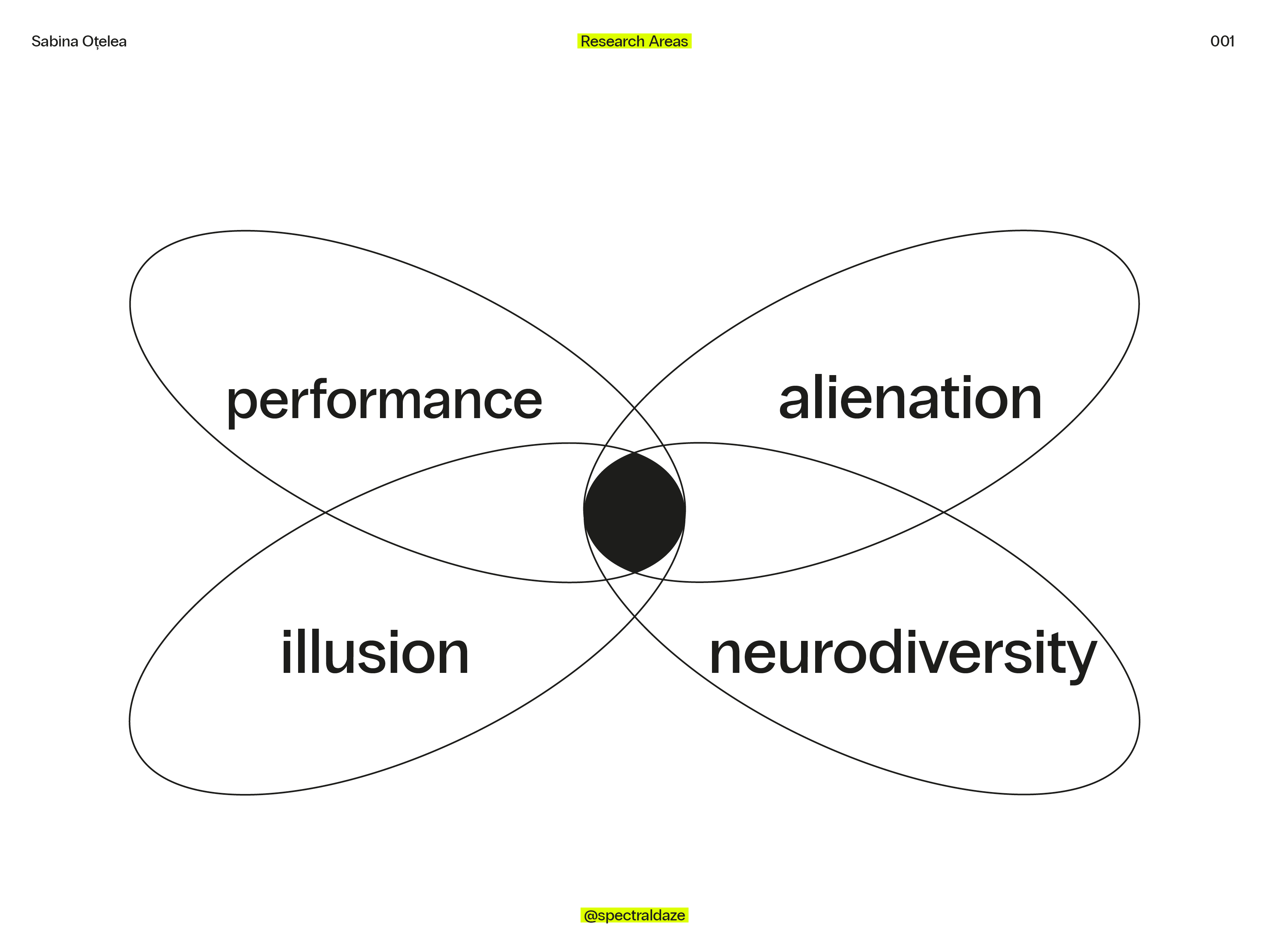
The research areas that I have been investigating for the last 6 months or so have been performance, alienation, illusion and neurodiversity, and the work I will be showing you and discussing today lies at the intersection of these research topics.
It all started as more of a personal exercise of understanding my own performativity. As a neurodivergent individual, my own life can feel like a performance, staged to help me adhere to certain social parameters. And, as a non-binary individual that has been socialised as a woman for most of their life, femininity has oftentimes felt like something I had to perform because of the way my appearance was being perceived by others.
This personal exploration then permeated my design work, with the intention of understanding the role my design practice plays in my own self-investigation. This made me realise that my practice has never been so much about self-expression, but different types of investigation.
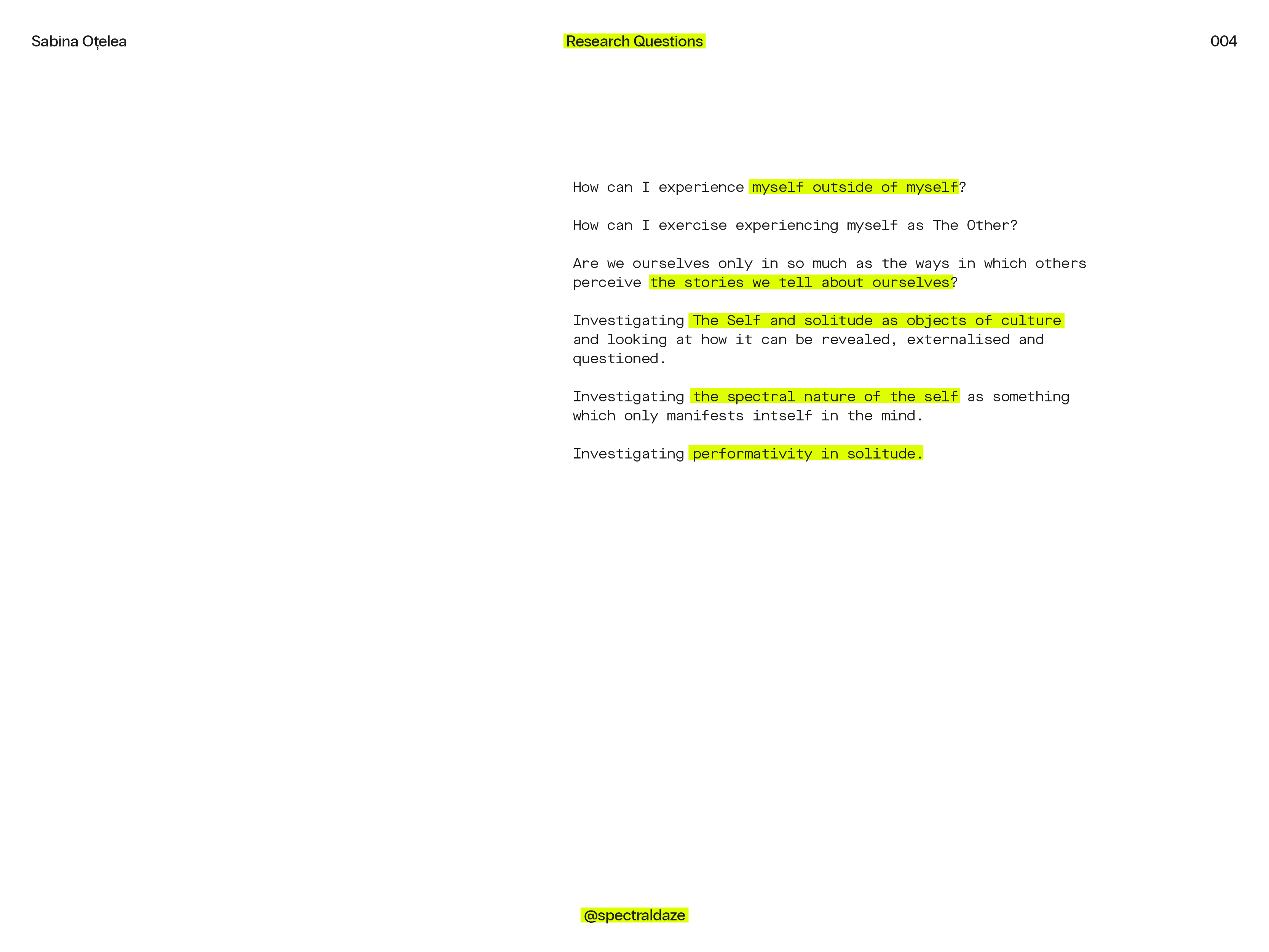
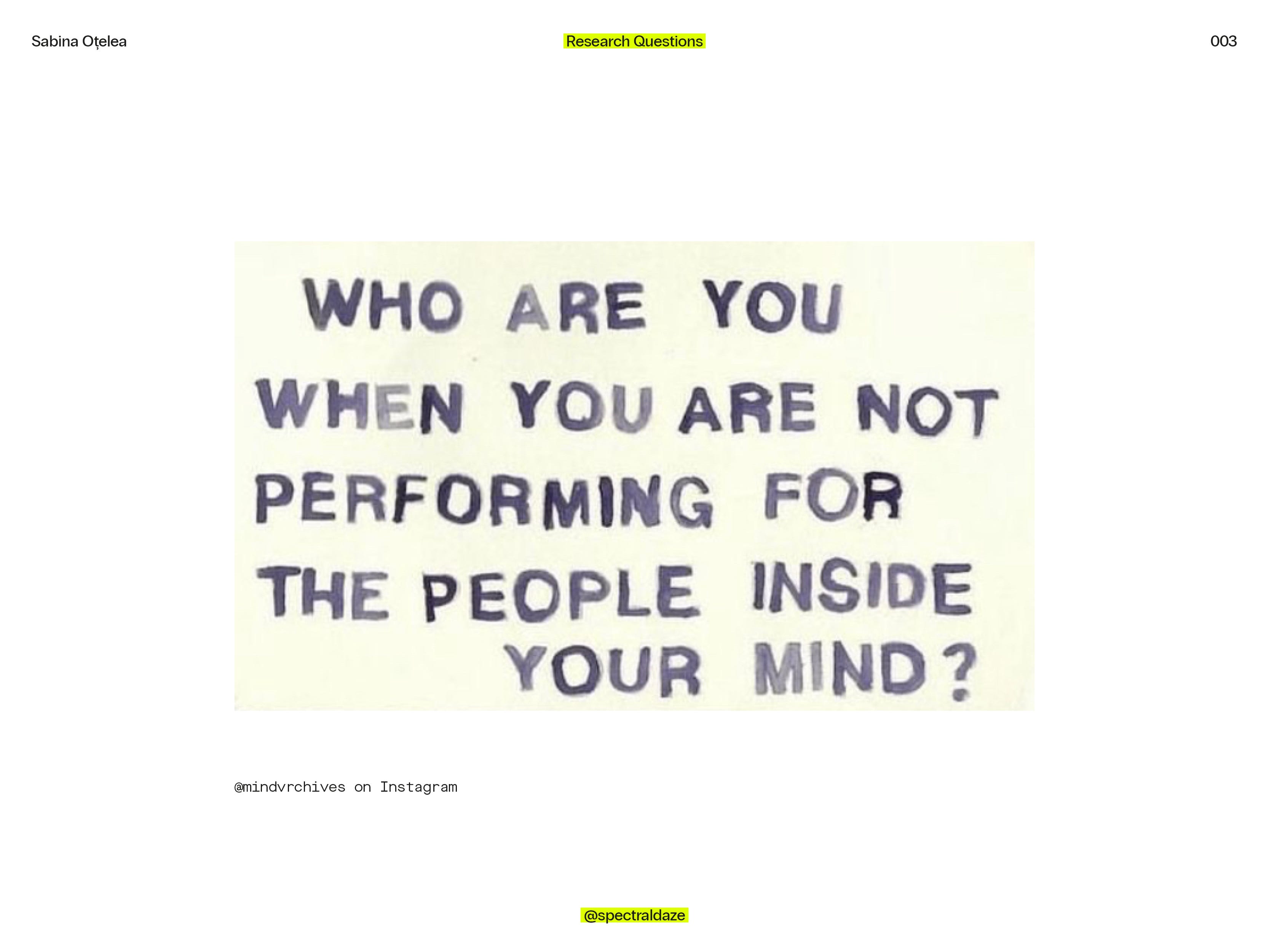
This time around, the investigation was that of The Self as The Other, and the spectral nature of the self, particularly in online spaces. But how do the stories we tell about ourselves influence us? How do we experience these narrational avatars? I started looking into performativity in solitude (i.e. who are we when we are alone?), and the self and solitude as objects of culture.
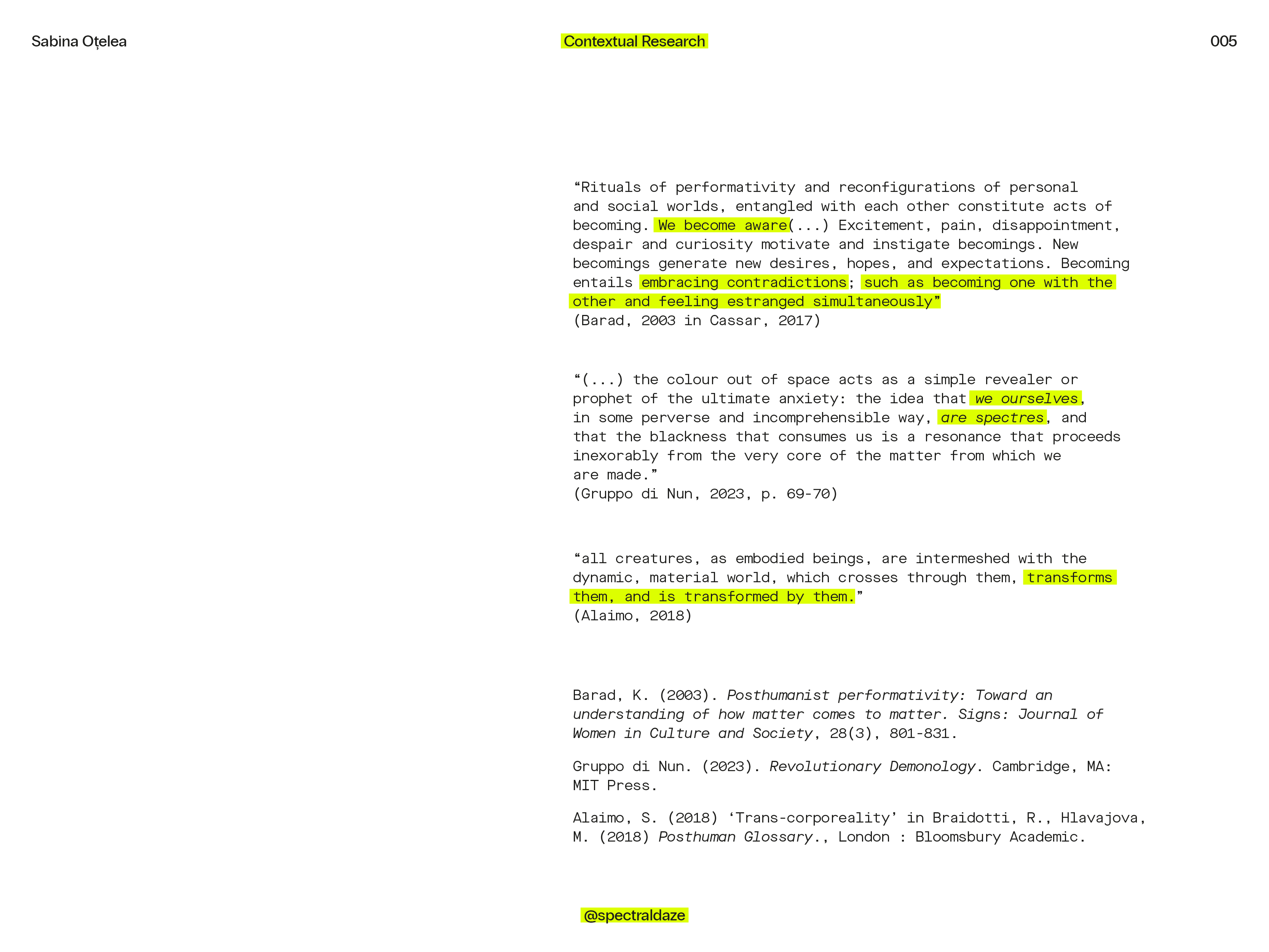
For this, I referred to Karen Barad’s “Posthumanist Performativity”, a text which encourages readers to embrace contradictions, such as becoming one with the other and feeling estranged simultaneously, Stacy Alaimo’s concept of trans-corporeality, through which all bodies are intermeshed with our dynamic, material world and are transformed and re-configured at any given moment, and Gruppo di Nun’s ideas of “Spectral Materialism”.
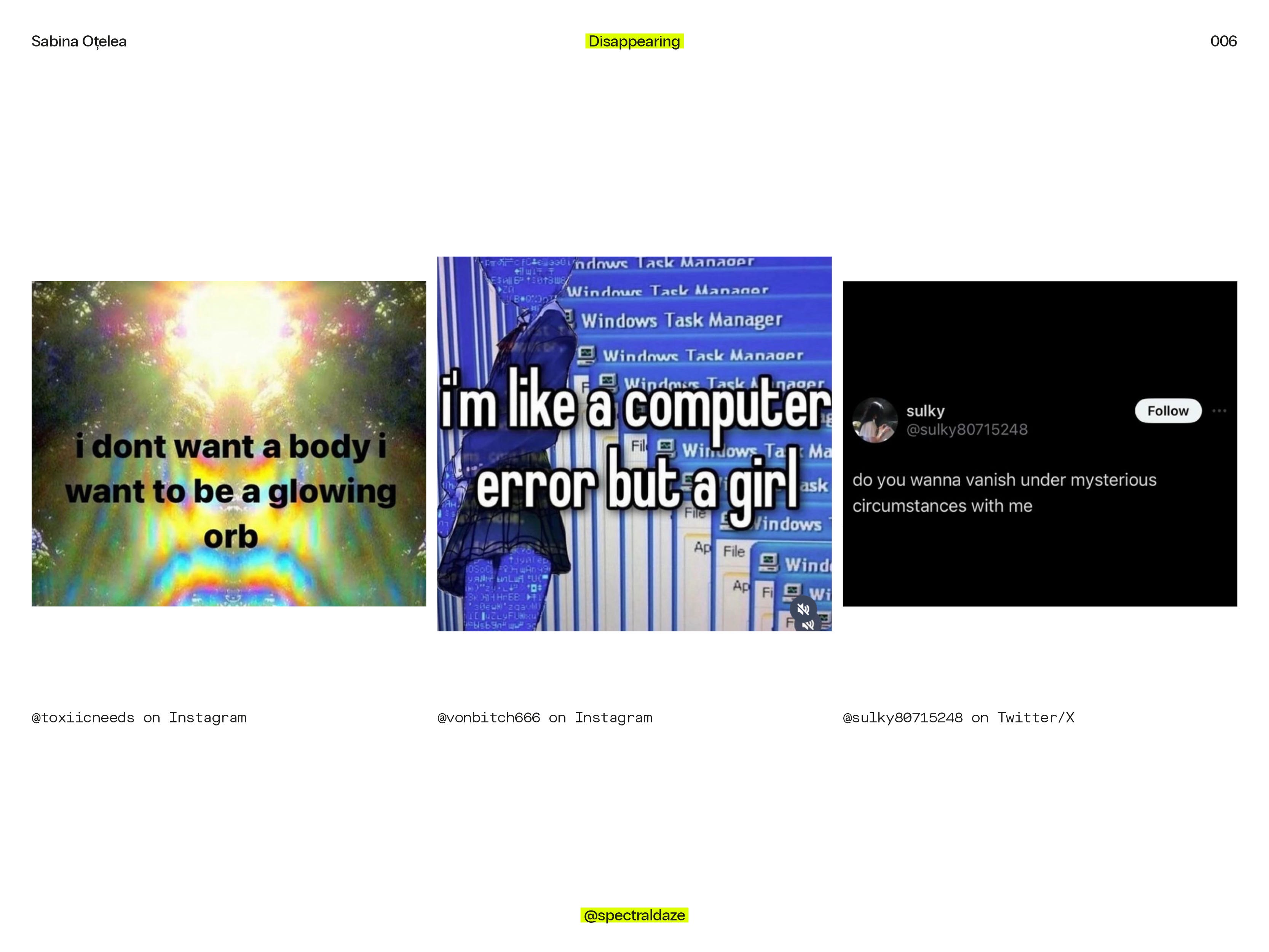
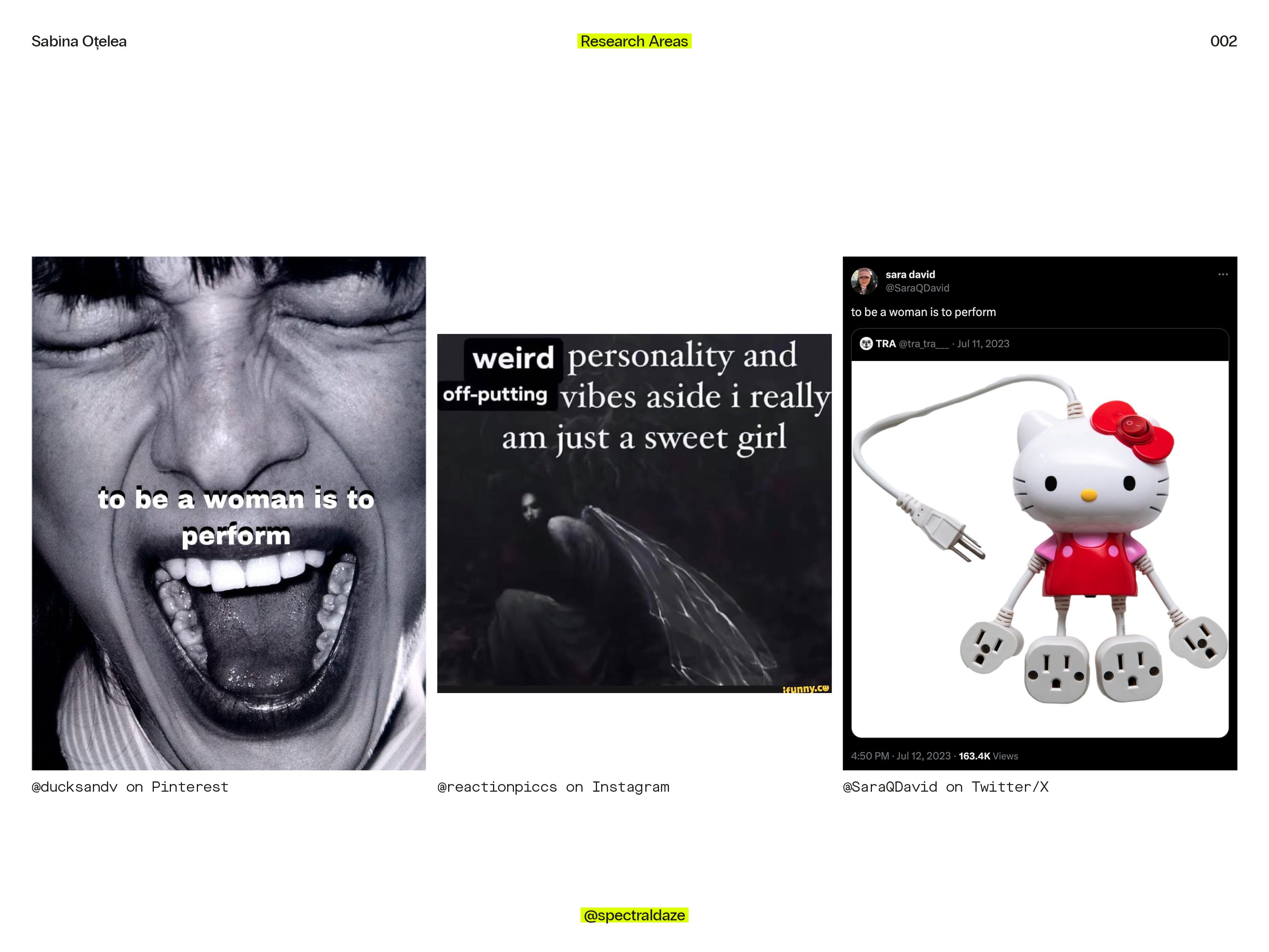
But then again, bodies are intrinsically physical, and online spaces can offer us ways to add to our physical form. These are some examples I have found online of images I deeply relate to, but have no way of explaining other than a collective desire to disappear, as abstractions of the self outside of a physical, materialised body. And I think there’s very particular online subculture that engages in this kind of discourse that seems to made up of people from my/our generation.
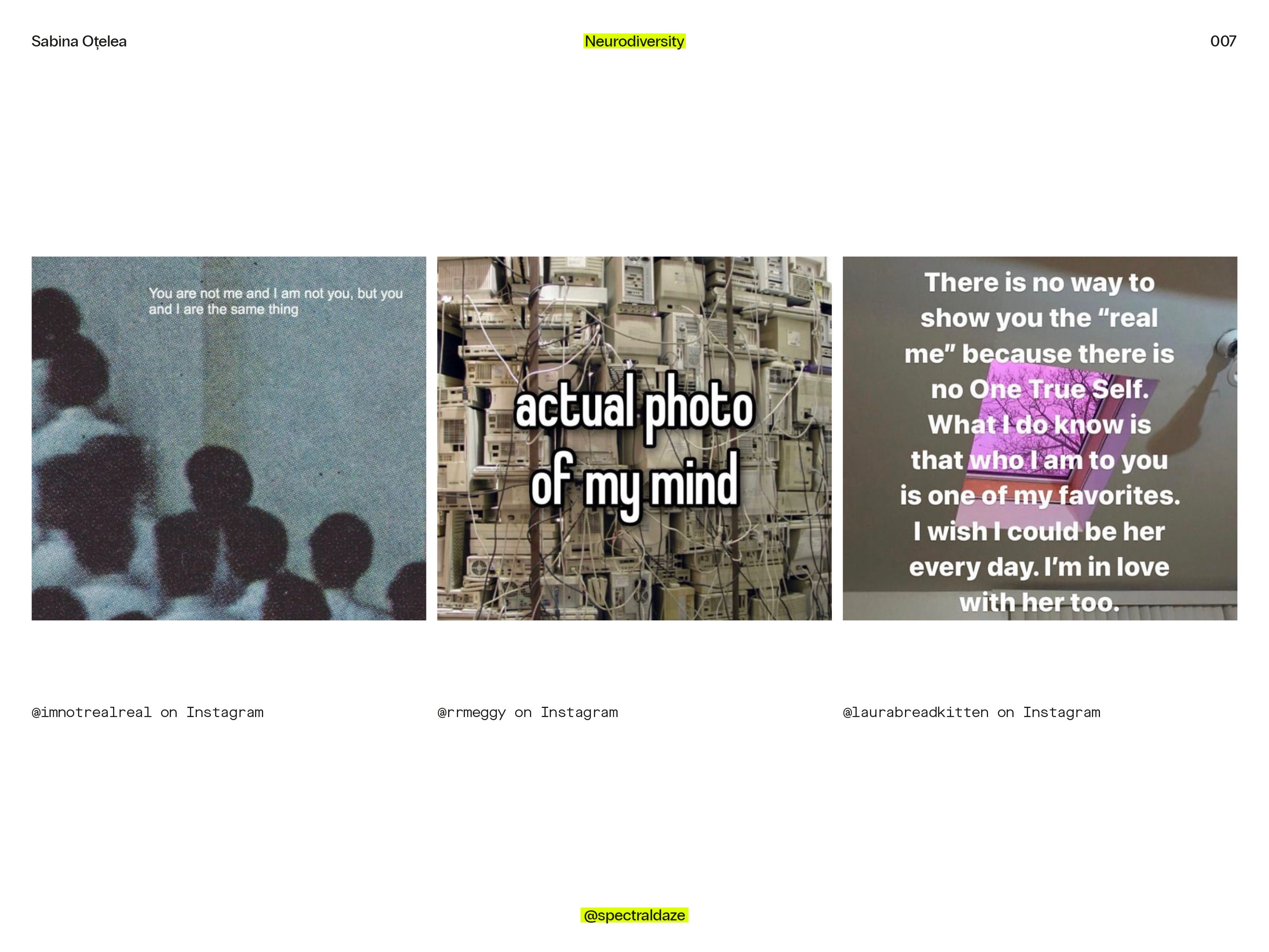
This also applies within the context of neurodiversity, where your performance of yourself becomes the You that exists in other people’s minds, but maybe is so far removed from your experience of yourself that it becomes The Other.
We’re going to get to my design work in just a second, but before that, this quote by poet Richard Siken has been a guiding light for the conceptualisation of my project: “Sometimes you get so close to someone you end up on the other side of them”. I felt it perfectly encapsulated the feeling I was struggling not only to describe, but also invites others to experience it as an exercise of self-investigation. So, how can we bring this feeling into a gallery space in a more embodied way?
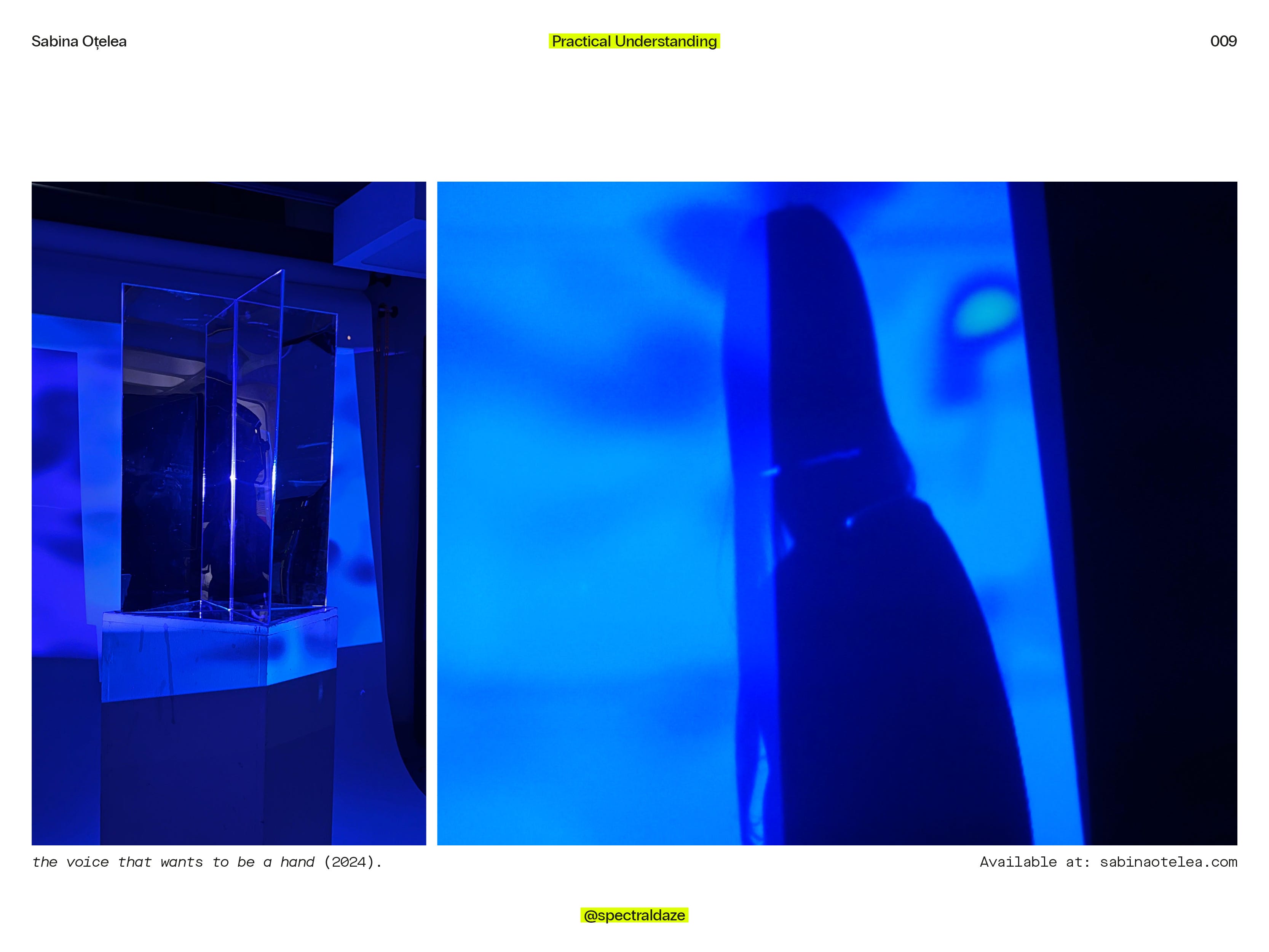
This is how the voice that wants to be a hand materialised. the voice that wants to be a hand is an audio-visual installation that is centred around a sculptural object: a set of mirrors that can simultaneously create three images of the participant involved, two that are mere reflections, and one that presents an inverted image. This object acts as an anchor within a space participants are only able to experience one at a time. Participants enter a space of solitude, in which the experience that the voice that wants to be a hand produces is outlined by the sound-making that the participant engages in.
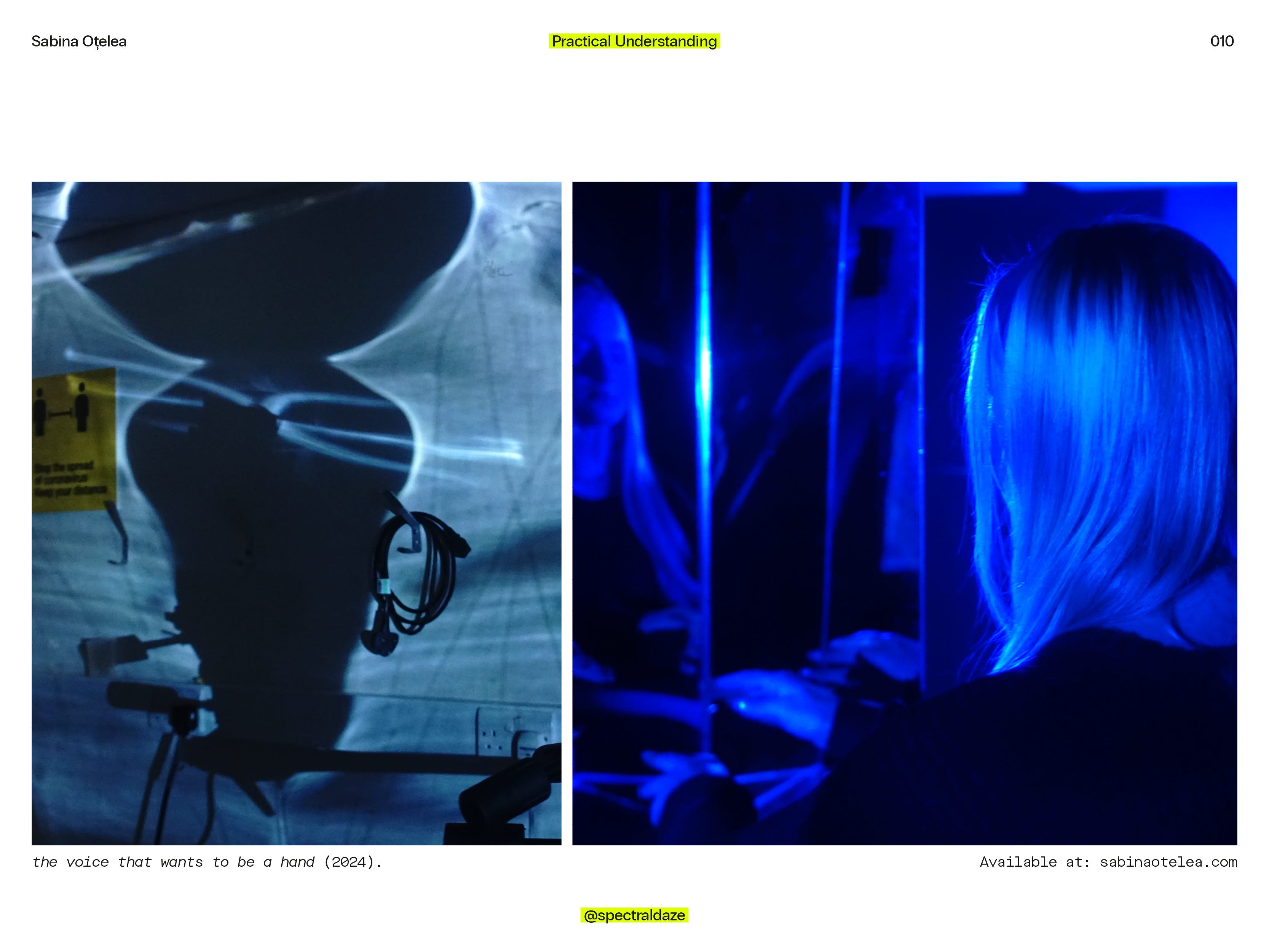
A system involving live-audio input, projected audio-reactive visuals and a speaker create an immediate spatial portrait of the way the participants’ presence affects the space. Engaged in their own solitude, participants are confronted with the feedback of the sounds they produce, distorted, spliced, and reorganised as part of a sonic performance.
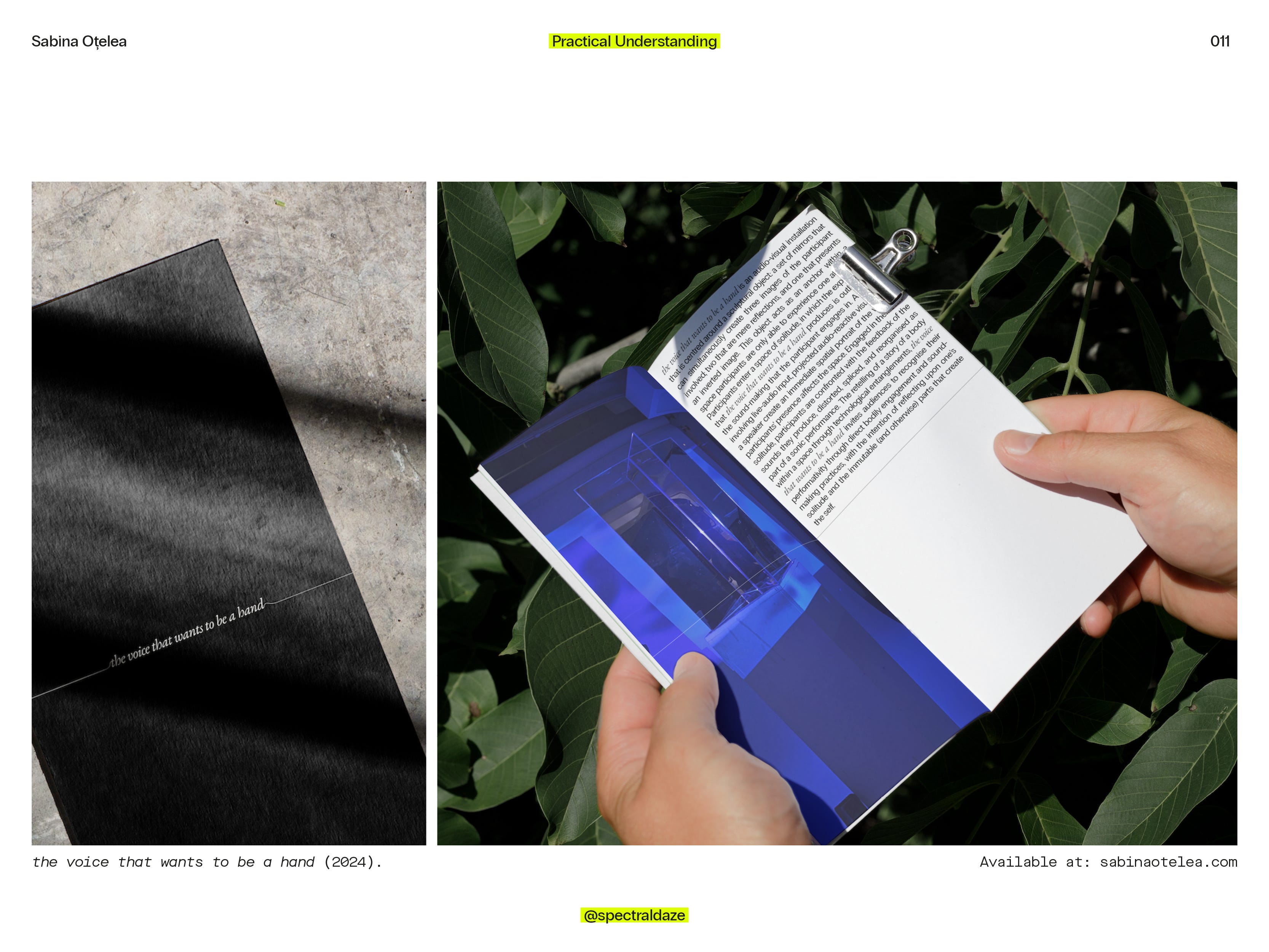
The retelling of a story of a body within a space through technological entanglements, this installation invites audiences to recognise their performativity through direct bodily engagement and sound-making practices, with the intention of reflecting upon one’s solitude and the immutable (and otherwise) parts that create the self. This exploration has revealed time after time within my practice that searching for something might just reveal the scarcity of its presence. We are rarely in solitude, almost always surrounded by idle technologies. the voice that wants to be a hand came into being from an ultimate desire for connection, a reaching-out towards others and, most importantly, towards ourselves, as a starting point for understanding our presence, the spaces and roles we occupy in the world and how our understanding of ourselves, through active processes of self-reflection, can be achieved through alternative embodied technological means.
Bibliography:
Cage, J. (1961) Silence: Lectures and Writings by John Cage. Middletown, Conn. : Wesleyan University Press.
Haraway, D. (2016) "Sympoiesis: Symbiogenesis and the Lively Arts of Staying with the Trouble" in Staying with the Trouble: Making Kin in the Chthulucene. Durham, North Carolina ; London, England : Duke University Press.
Haraway, D. (1991) "A Cyborg Manifesto. in Simians, Cyborgs, and Women. The Reinvention of Nature. New York: Routledge.
Barad, K. (2003). “Posthumanist Performativity: Toward an Understanding of How Matter Comes to Matter.” Signs: Journal of Women in Culture and Society 28, 3: 801-831.
Alaimo, S. (2018) 'Trans-corporeality' in Braidotti, R., Hlavajova, M. (2018) Posthuman Glossary., London : Bloomsbury Academic.
Gruppo di Nun (2023) 'Spectral Materialism' in Revolutionary Demonology. London: Urbanomic.
Lovecraft, H.P., Klinger, L.S., Moore, A. (2014) 'The Colour Out of Space' in The new annotated H.P. Lovecraft. London: Liveright. Originally published in 1927.
Bradbury, R. (2008) Something wicked this way comes. London, England : Gollancz. Originally published: New York: Simon & Schuster, 1962. London: Hart-Davis, 1963.
'Catoptromancy' (2023) Available at: https://www.oed.com/dictionary/catoptromancy_n?tl=true (Accessed: 18/12/2023)
'Catoptromancy' (2023) Wikipedia. Available at: https://en.wikipedia.org/wiki/Catoptromancy (Accessed: 18/12/2023)
Occult World (no date) Catoptromancy. Available at: https://occult-world.com/catoptromancy-divinations/ (Accessed: 18/12/2023)
Astonishing Legends (2019) Catoptromancy. Available at: https://astonishinglegends.com/astonishing-legends/2019/9/22/catoptromancy (Accessed: 18/12/2023)
Spork Press (no date) Editors' Pages: "The Long and Short of It" by Richard Siken. Available at: https://thisissporkpress.com/2_1/Pieces/Siken.htm (Accessed: 17/12/2023)
• • • • • • • • • • • • • • • • • • • • • • • • • • • • • • • • • • • • • • • • • • • • • •
cover image by @toxiicneeds